

Htv Vs. Sublimation: Which Method Is Right For Your
Jul
If you are new to the world of custom crafting, you have likely come across two major heavyweights: Heat Transfer Vinyl (HTV) and Sublimation. Both methods allow you to create stunning, personalized items, but they use completely different technology, materials, and techniques.
Understanding the fundamental differences between the two is the key to choosing the right tool for the job, saving you time, money, and a lot of crafting frustration.
Let’s break down HTV versus Sublimation so you can decide which method reigns supreme for your next masterpiece.
Understanding the Methods: The Crash Course
What is HTV (Heat Transfer Vinyl)?
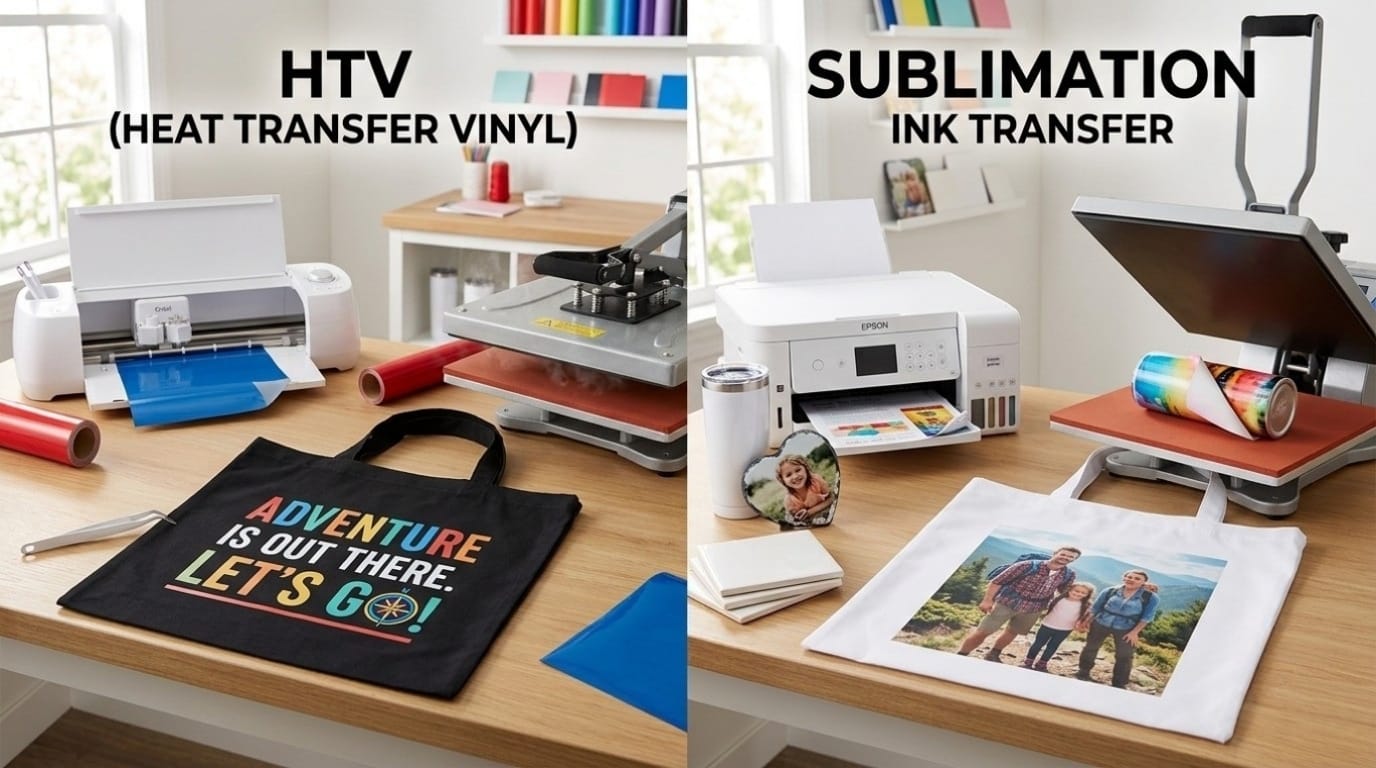
Think of HTV as a high-tech sticker that needs heat to activate its adhesive. You use a cutting machine (like a Cricut or Silhouette) to cut a design out of a sheet of vinyl. You then “weed” away the excess material, place the design onto your blank, and apply heat and pressure. The heat melts the adhesive, bonding the vinyl layer onto the surface of the material.
What is Sublimation?
Sublimation is a scientific process where a special ink turns into a gas when heated. When you press a sublimation transfer onto a compatible blank, the heat opens up the pores of the material, and the ink (now a gas) infuses into the fibers or the coating. When it cools, the pores close, trapping the ink inside. The design becomes part of the material itself.
The Comparison: Head-to-Head
1. Fabric Compatibility
- HTV: HTV is versatile. It bonds best to cotton, polyester, and poly-blends. Because it sits on top of the fabric, you can use it on virtually any smooth fabric surface, including dark colors.
- Sublimation: This method requires high-polyester content (at least 65%) or specific polymer coatings. It will not work on 100% cotton. Sublimation works best on white or light-colored fabrics because the ink is transparent.
2. Design Complexity & Color
- HTV: Excellent for solid colors, bold shapes, names, and logos. While you can layer different colors of vinyl, complex, multi-colored designs (like photographs) are difficult and time-consuming.
- Sublimation: This is where sublimation shines. Because it uses a printer, you can transfer full-color photographs, complex gradients, and intricate patterns flawlessly in a single press.
3. Feel & Durability
- HTV: HTV has a noticeable “hand” or feel. Depending on the type of vinyl (flock, glitter, smooth), you can feel the design sitting on top of the fabric. Over time, and after many washes, HTV can potentially crack or peel.
- Sublimation: Sublimation has zero feel. The fabric remains completely soft and breathable. The design is incredibly durable and won’t crack, peel, or fade for the life of the garment.
4. Setup & Equipment Cost
- HTV: Lower barrier to entry. You need a cutting machine (like a Cricut), a heat press or iron, and sheets of HTV. This is often the starting point for most hobby crafters.
- Sublimation: Higher initial investment. You need a dedicated sublimation printer, sublimation ink, sublimation paper, and a quality heat press. (You cannot use a standard inkjet printer).
The Verdict: Which One Do You Need?
Choose HTV If:
- You are a beginner just starting your crafting journey.
- You love working with 100% cotton or dark-colored fabrics.
- Your designs are mostly simple logos, names, or quotes in solid colors.
- You want to experiment with different textures like glitter, holographic, or flock finishes.
Choose Sublimation If:
- You want to print full-color photographs or complex artistic designs.
- You want the softest, most durable professional finish possible.
- You want to personalize hard substrates like tumblers, tiles, slates, and photo panels (using compatible sublimation blanks).
- You are scaling a business and need efficiency for multi-colored prints.
Ready to Start Creating?
Both HTV and Sublimation are fantastic tools that deserve a place in any crafter’s arsenal. At Kraftsentials, we are proud to support your creativity with a wide range of premium sublimation blanks and essential crafting supplies.